
The emporers have no marketing
None of the hottest private AI companies has a CMO right now. Not OpenAI. Not Anthropic. Not Cursor. Not Perplexity.
I'm not pointing this out to be snarky. It's actually understandable, and I'll get to why in a minute. But we're now at the point where the absence of real marketing leadership isn't just a missed opportunity. It’s becoming a liability.
AI, overall, has a marketing problem
A March 2026 Pew Research study found that half of U.S. adults feel more concerned than excited about AI's increasing role in daily life. Just 10% say they're more excited than concerned. And the trend is going in the wrong direction: back in 2021, 37% of people said they were more concerned than excited. It's gotten worse, not better, as the technology has become much more powerful.
There's no AI lobby. No centralized governing body running an "actually, this is good for you" campaign. What there is: a handful of companies with enormous reach, enormous resources, and an enormous opportunity to collectively shape what AI means to the world. If the most prominent companies got serious about marketing at the same time, they could do more to build public trust in AI than any policy document or congressional hearing. They don't have to coordinate. They just have to care. Right now, most of them don't seem to.
Why they're here
Before I get into it, it's worth acknowledging how they got here and why these extremely well-funded AI companies not prioritizing marketing made sense for a while.
For the last several years, the most important marketing these companies could do was to recruit and retain the best researchers and technical talent. In a war for the best minds in AI, your papers, your GitHub repos, your Discords, and your founders' Twitter feeds were your marketing. If you could get the smartest people in the world to want to work for you, everything else followed.
That was the right call. The problem is that many of these companies are still operating like that's the only game to win. They've built powerful echo chambers and mistaken them for brand strategies.
That window is closing. AI is no longer just a research project. It’s fucking everything. The audience has expanded dramatically, and the marketing hasn't kept up.
Who actually needs to talk to consumers?
Who should actually be doing Super Bowl ads? Not every company on this list has the same obligation to consumers, and confusing that leads to wasted effort and a diluted brand.
OpenAI has to. It's already a consumer company whether it planned to be or not. Anthropic should, but narrowly and deliberately. Cursor and Perplexity don't need mass consumer marketing right now and would be making a mistake to chase it. Their audiences are specific, and specificity is a strength.
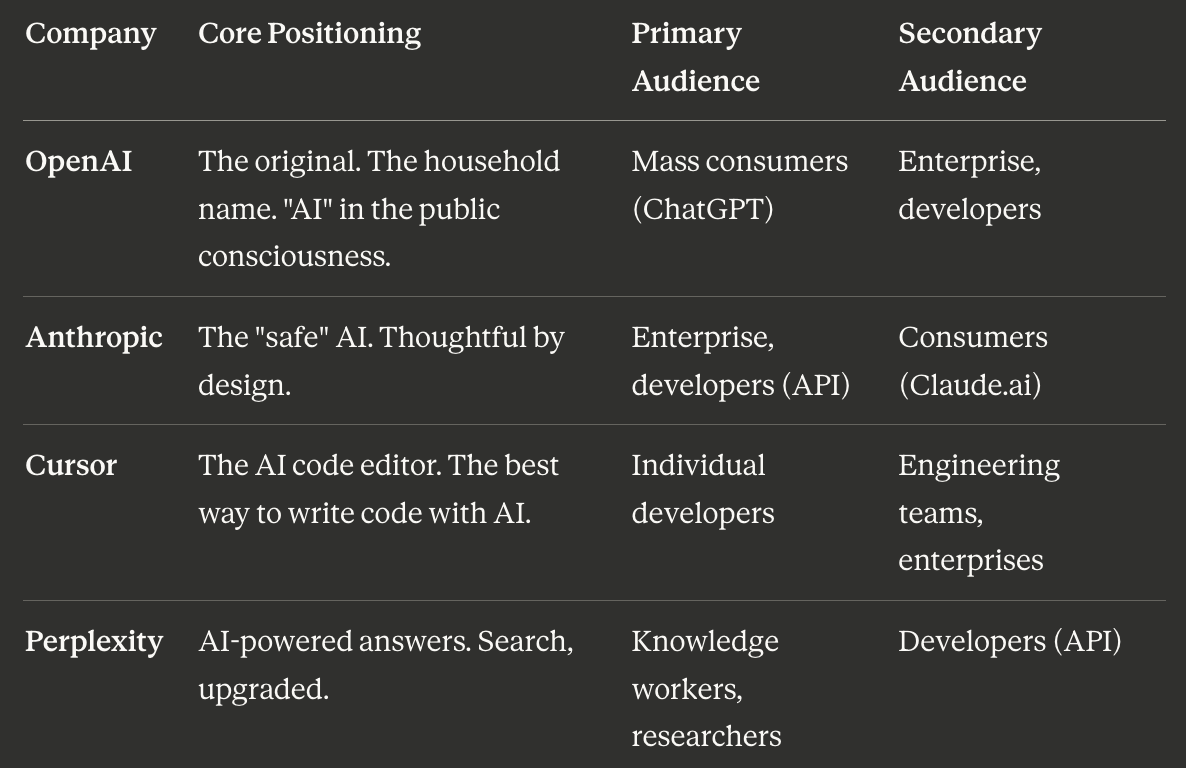
Landscape
OpenAI: Stop being everything to everyone
OpenAI has the most powerful brand in tech right now. ChatGPT is Kleenex. People don't say "I'll ask an AI," they say "I'll ChatGPT it." That's remarkable, and they're somehow squandering it.
The problem is that OpenAI is trying to be a consumer product, an enterprise suite, a developer platform, and a hardware company simultaneously, loudly, with no coherent narrative tying it together.
The consumer product and the enterprise push are pulling in different directions. ChatGPT's cultural presence is fun and a little chaotic, which works for consumers. Enterprise buyers don't buy from chaotic. They buy from stable, trustworthy, inevitable. You can't be both without a clear architecture for your brand: separate identities, separate voices, one parent brand holding it all together.
On the consumer side, OpenAI also has the biggest platform of any company in this group to address the broader public conversation about AI. What it is, why it matters, what to actually worry about versus what's noise. The Pew numbers above should terrify them. They're largely leaving that opportunity on the table.
So, what?: Separate the consumer and enterprise brands in tone and channel, even if they share a name. ChatGPT stays playful and cultural. ChatGPT Enterprise gets its own voice: measured, proof-forward, built on case studies. Then build a content engine around Sam Altman, not the reactive posts, but the long-form thinking. The op-eds. The sit-down interviews. A founder who can articulate a vision better than anyone in the industry is worth ten ad campaigns.
Own "the default." When someone says "just use AI for that," they should mean ChatGPT. That's both a product and a brand problem, and right now, the marketing isn't helping either.
Anthropic: Lead with Claude, not the mission
I have a lot of respect for Anthropic’s mission. The commitment to safety is real, and it matters. But "we're the safe AI company" is a terrible marketing strategy.
Safety is a minimum bar, not a differentiator. No one chooses a product because it's safer. They choose it because it's better, and feel reassured that it's safe. That's a different thing. The mission supports the brand; it doesn't become the brand.
Claude is a better writer, a better reasoner, a better collaborator than most people expect. The product is actually doing so much marketing work with every delightful detail in its UI. Take a step back and figure out how to spotlight those details for people who haven’t used Claude yet (which is a lot more people than ChatGPT).
But the primary audience doesn’t need to be everyone with a phone. It's the professionals, creators, and knowledge workers who would become deeply loyal if they actually discovered Claude. These are high-lifetime-value users who evangelize once you find them. You don't really need Super Bowl ads. You need the right people to have a genuinely surprising experience with the product, and a place to talk about it.
So, what?: Make Claude the character. Not a mascot, a personality. Claude has a distinct voice: curious, thoughtful, precise, a little warm. Lean into that. Let the product be the story. Ship great demos. Get into the long-form workflows that make people stop and say, "I can't believe it did that."
For enterprise, which is the real revenue driver, the message isn't "safe AI" but "the AI your team will actually trust." Trust is earned through performance, transparency, and reliability. Anthropic has all three. Show it.
Own "the thoughtful choice." Not safe. Not boring. Considered. There's a growing segment of buyers making AI-related decisions carefully, and they want to buy from a company that takes it as seriously as they do.
Cursor: Don't let the hype be the brand
Cursor has something rare: a product people love enough to evangelize without being asked. The organic word-of-mouth is genuinely strong, but we have yet to hear from Cursor itself.
The risk is confusing virality with brand. They're not the same thing.
Virality gets you in the door. Brand is what keeps you in the room when GitHub Copilot ships a feature, Windsurf cuts their price, or something new drops next quarter. In developer tools, something new always drops next quarter.
Cursor does not need mass consumer marketing. The moment you try to speak to everyone, you lose the audience that actually matters. Developers who love you right now will feel the shift immediately. The goal isn't reach. It's depth.
I’ve spent a lot of time thinking about developer marketing. The companies that win long-term with developers don't just have good products. They have a point of view about how software should be written. Stripe had one. GitHub had one. Cursor needs one.
So, what?: Build the community faster and more intentionally. The most loyal Cursor users right now are essentially unpaid evangelists. Find them. Give them early access, credit, and visibility. Turn them into the face of the brand. But make sure they are exactly who you want to be the face of the brand, not someone just with a lot of followers or an affinity for speaking at events. Show some range in who these faces are by having both individual developers and industry veterans.
Then invest in content with a genuine point of view. Not "here's how to use Cursor" demos (though those matter). Actual thinking: What does it mean to write code with AI as a true collaborator? What does the craft of software development look like in 2026? Cursor has a front-row seat to one of the most interesting shifts in how software gets made. Write about it.
Own "how great engineers work." Not the tool. The practice.
Perplexity: Pick a fight you can win
Perplexity has a structural positioning problem. They're competing with Google on a dimension where Google has a 25-year head start and essentially infinite resources. That's a fight they cannot win on Google's terms.
But there's a fight they can win, and no one's claiming it: the "think" category. Not search. Research. Not where do I find information, but how do I actually understand it.
Knowledge workers, researchers, analysts, journalists: these are people who don't just need an answer. They need to know why the answer is right, what they might be missing, and what to look at next. That's a fundamentally different product experience than Google, and one Perplexity is actually built to deliver.
Like Cursor, Perplexity doesn't need mass consumer marketing (even if that’s how they started out). The instinct to go broad and compete with Google for everyday queries would be a mistake. The users who will love Perplexity most are not the ones who Google everything. They're the ones currently spending an hour across twelve browser tabs trying to synthesize something. Go get them specifically.
So, what?: Get extremely specific about the use cases. Show a journalist using Perplexity to research a story. Show an investor prepping for a board meeting. Show a product manager before a competitive review. Show how serious attorneys use Perplexity in their work. These aren't demos, they're identity plays. You're telling the audience: this is for people like you, doing work like yours.
Then stop trying to beat Google on volume and start winning on depth. Google finds. Perplexity understands. That distinction is real and worth owning completely.
Own "serious research." Not the fastest search. The smartest one. For people who need to think, not just find.
Let’s go
Every one of these companies has a credible claim to something important. But right now, they're mostly talking about the same things: capability, speed, safety, intelligence, in voices that are hard to tell apart.
The companies that win this next phase won't be the ones with the biggest marketing budgets. They'll be the ones who figure out their story first and have the discipline to stick to it. Done right, that also means something bigger: collectively, they have the platform to shift how the world actually feels about AI. That's not a marketing problem. That's an opportunity most industries never get.
The window to get this right is shorter than people think.